



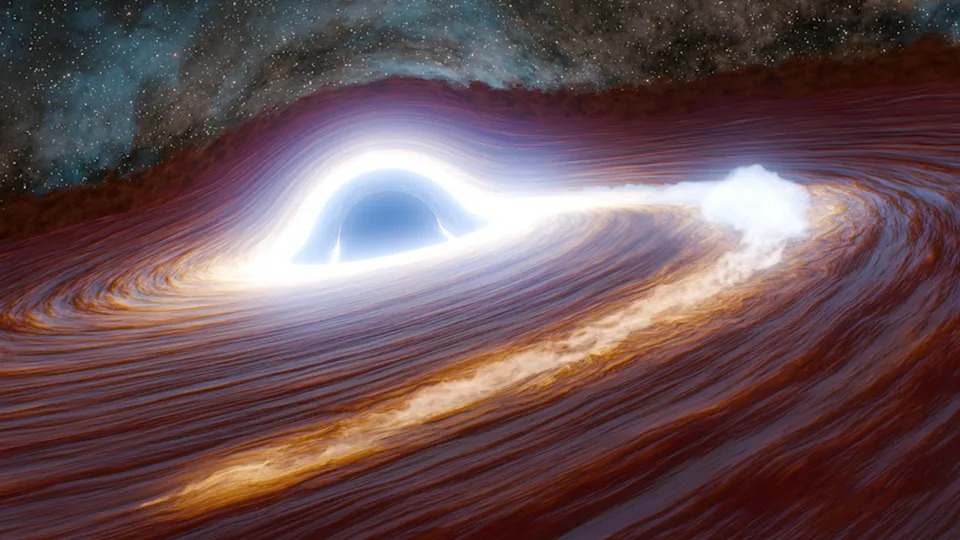
TLDR: Scientists have discovered the largest black hole recorded, located 1.1 billion light-years away, with a mass over 30 billion times that of the Sun. This finding enhances our understanding of black hole formation, galaxy evolution, and the universe's expansion, highlighting advancements in observational astronomy.
In a groundbreaking discovery, scientists have identified the largest black hole ever recorded, located in a galaxy approximately 1.1 billion light-years away from Earth. This extraordinary black hole is estimated to have a mass that is over 30 billion times that of our Sun, setting a new benchmark in the study of black holes. The findings provide crucial insights into the formation and growth of these enigmatic cosmic entities.
The research, which was published in a prominent scientific journal, highlights how astronomers utilized advanced observational techniques, including data from powerful telescopes, to pinpoint the black hole's position and measure its mass accurately. This discovery raises intriguing questions about the evolution of galaxies and the role supermassive supermassive black holes play in shaping their surroundings.
Interestingly, the new black hole is located in a galaxy that exhibits unusual characteristics, suggesting that it may have undergone significant interactions with other galaxies. These interactions could have facilitated the growth of the black hole to such an immense size. Researchers are eager to explore these dynamics further to understand how black holes influence galaxy formation and structure.
This discovery also has implications for our understanding of the universe's expansion and the behavior of matter under extreme gravitational conditions. As scientists continue to investigate the properties of black holes, they hope to unravel the mysteries surrounding these powerful phenomena that challenge our current understanding of the universe.
Such monumental findings not only enhance our knowledge of astrophysics but also inspire future explorations in the field. The study of black holes remains a rapidly evolving area of research, and this latest discovery is a testament to the remarkable advancements being made in observational astronomy.
Please consider supporting this site, it would mean a lot to us!
