



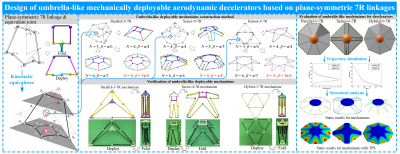
TLDR: Recent advancements in aerospace engineering have led to innovative umbrella-like aerodynamic decelerators using a 7R linkage system for efficient deployment. This technology enhances safety, reduces weight, and adapts to various atmospheric conditions, promising improved precision for space missions and potential applications in other fields.
Recent advancements in aerospace engineering have led to the innovative design of aerodynamic decelerators that utilize a unique umbrella-like structure. This cutting-edge technology is based on mechanical linkages, specifically a plane symmetric 7R linkage system, which allows for efficient deployment and retraction during flight. The development of these decelerators aims to enhance safety and control for various aerospace applications, including space capsules, atmospheric entry systems, and high-altitude drones.
The design process involves intricate engineering, where the 7R (seven revolute) linkage system provides a robust framework for the decelerator's expansion and contraction mechanisms. This system enables the decelerator to unfold in a controlled manner, optimizing its aerodynamic profile to slow down vehicles as they navigate through the atmosphere. The efficiency of this design is crucial, as it directly impacts the success of missions that require precision landing capabilities.
One of the key benefits of the umbrella-like aerodynamic decelerators is their ability to adapt to varying atmospheric conditions. As vehicles enter different layers of the atmosphere, the deployment mechanism can adjust accordingly, ensuring that the decelerator works effectively under diverse circumstances. This adaptability is essential for missions where accurate landing is paramount, such as those involving crewed spacecraft returning from orbit.
In addition to enhancing safety, these advanced decelerators also aim to reduce the overall weight and complexity of current systems. By utilizing the plane symmetric 7R linkage design, engineers can create a more streamlined and efficient structure, which is vital for modern aerospace endeavors. This approach not only improves performance but also contributes to the sustainability of space missions by minimizing material usage.
The future of aerospace technology looks promising with the integration of these umbrella-like decelerators. As research continues and prototypes undergo testing, the potential applications extend beyond space travel. Innovations stemming from this technology could revolutionize various fields, including unmanned aerial vehicles and emergency response systems, paving the way for safer and more efficient operations in challenging environments.
Please consider supporting this site, it would mean a lot to us!
